
What to expect during your first Ocrevus infusion.

Our story in a nutshell:
- Boy gets sick
- Boy sees multiple specialists
- Boy gets diagnosed years later with MS
- Boy gets treatment options
- Boy chooses Ocrevus infusions
For more details of our medically induced woes, you can check out my previous posts here (the beginning) here (the middle) and here (the follow-up).
If you are reading this post, odds are you, or someone you love, is dealing with an MS diagnosis. Or maybe you are reading this because you are my friend/family and I led you here for detailed updates on how BJ and I are doing (hi Mom).
The first thing I want to make clear is that currently, there is NO CURE for MS. Any treatment your doctor may consider is to help delay the progression of the disease.
There are a variety of treatment options for relapsing/remitting MS (the kind BJ has) and that is what I will be focusing on. For a list of the different types of MS click HERE.
The treatment options for relapsing/remitting MS are currently oral medications, self  injection, or infusions. A doctor or specialist will go over the pros and cons of each method, and work with the patient to determine what medication is a good option. It was recommended that BJ start his treatment with the infusion method and the relatively new drug, Ocrevus.
What is Ocrevus?
Ocrevus is an intravenous infusion medication that targets certain white blood cells in the body that have been shown to contribute to nerve damage in people with MS. After the initial treatment, which is split up into two sessions, two weeks apart, Ocrevus only needs to be administered once every 6 months.
The Insurance Hurdle
Ocrevus was approved by the FDA in March of 2017, so it is a relatively new drug on the market. 30,000 people were prescribed Ocrevus the first year it was released. Because Ocrevus is the new kid on the block, and because it comes with a pretty hefty price tag of $65,000 a year, some insurance companies have balked at patients starting with Ocrevus as their first treatment option. 
Ocrevus is one of the most aggressive forms of treatment for relapsing MS. BJ and I were warned our insurance company may require him to try another type of treatment first before approving us for Ocrevus. Luckily, our insurance company was on-board with our doctor’s recommendation, and BJ’s treatments are covered 100%.
For under insured people, or those with high deductibles, Ocrevus offers a supplemental plan that will cover up to $10,000 a year in any out of pocket costs. They have an easy to navigate website where someone can sign up for benefits. You can view that website HERE.
Our Ocrevus Experience
Before being treated with Ocrevus, you must find a clinic that is certified to administer the medication. In our case, that was the Guthrie Infusion Clinic in Sayre, PA.


Our first appointment was for 10:00 in the morning on June 21. After checking in with the front desk, we were immediately taken into the back office where the infusion rooms are located. Each infusion room is curtained off for privacy and is equipped with a small television, a recliner for the patient, and chairs for visitors. We had two people assigned to BJ’s care, Adrian and Jim. They were both awesome. They checked BJ’s vitals to ensure that he did not have any underlying illness which could be intensified from the infusion, and they gave us a brief overview of what we could expect.
BJ was then fitted with an IV catheter, and Adrian administered a high does of Benadryl through the IV. This was to help BJ’s body ward off any infection. We then had to wait 30 minutes for the Benadryl to take effect. 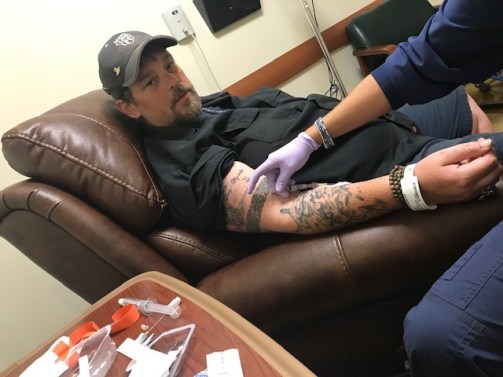
One of the plusses of the Benadryl injection was that the medication went to BJ’s head and gave him quite a buzz. He ended up sleeping on and off for the first few hours of the infusion treatment.
Once the Benadryl had a chance to work, BJ’s vitals were taken a second time, and he was then hooked up to the IV drip with the Ocrevus medication. They started the drip on a slow setting, and would increase the speed of the drip every half hour as long his vital were steady.


Once BJ was hooked up to the IV, we were given a menu to choose our complementary lunch. There was also a kitchen we had free access to with drinks and snacks.
For the next 3 hours, BJ slept off and on, while I read in a nearby chair. Our lunch came around noon, and after our meal I went back to reading and BJ spent some time catching up on social media on his phone. 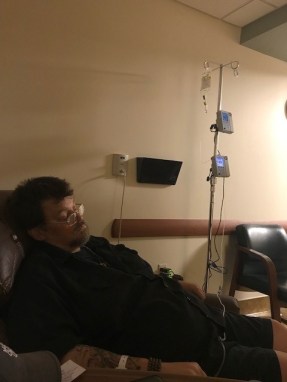
The only incident BJ had during the treatment was some profuse sweating. It was undetermined if the sweating was a side effect of the Ocrevus, but it messed with the hand-held temperature checker, and they were unable to get an accurate reading. They slowed the drip down a bit and the sweating eventually subsided.
Around 2:30, the treatment was done, and BJ was unhooked from the IV drip. The catheter was left in his arm in case drugs needed to be administered were he to have a reaction.
We needed to stay at the clinic for an hour after the infusion to make sure BJ was tolerating the drug. Aside from feeling very tired and a bit out of sorts, BJ was fine and we were able to go home. It is very important to have someone drive you to your appointments, as you will not be feeling up to driving once it is done.
A few hours after the appointment, BJ was feeling like he did before the treatment. The only thing we noticed was that he had a hard time sleeping that night as he was up every 45 minutes to use the bathroom. Again, we don’t know if this was a side effect or not.
It has been a few days since BJ had his treatment and he has been feeling good. If you have MS, you understand good-days and bad-days. All of the days following his treatment have been good ones. 
In two weeks, BJ has to go back for the second part of the treatment, and the protocol will be the same as the first time. As long as BJ tolerates the second treatment, he will start a schedule of Ocrevus infusions every 6 months.
In between treatments, there will probably be follow-up MRI’s to gage the effectiveness of the medication. Hopefully those images will show no new lesions and we can call this a success. I will update this post with a link HERE to any follow-ups once we have more information.
If you have any questions, drop me a line. I would be happy to help if I can.
 Work/Life Balance for the Anxious Gal